White House Cheers “Winning” Iowa — While Farm Country Feels the Squeeze
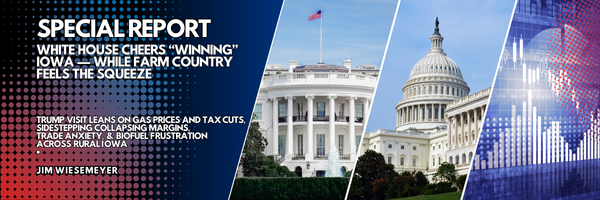
Trump visit leans on gas prices and tax cuts, sidestepping collapsing margins, trade anxiety, and biofuel frustration across rural Iowa
The White House’s advance narrative for President Donald Trump’s stop in Clive, Iowa (link) reads like a victory lap — but one that lands awkwardly in the middle of a farm economy still under real strain. The release is heavy on gasoline prices, tax savings, and housing metrics, yet conspicuously light on the pressures dominating conversations in coffee shops, co-ops, and lender offices across rural Iowa.
A consumer checklist in a producer state
The statement opens with gas and diesel prices, framing relief at the pump as proof that “Iowa families are winning again.” For rural voters, especially farmers, that emphasis rings hollow. Fuel is only one line item — and not the one driving today’s stress. Input costs remain elevated relative to crop prices, margins are thin to negative for many corn and soybean producers, and cash rents locked in during the inflation spike are only slowly resetting. Lower diesel helps, but it does not fix balance sheets.
“Roaring” GDP vs. shrinking farm margins
The White House touts Iowa GDP growth “fueled by agriculture,” but that macro framing masks the micro reality. Farm income volatility, weak export demand, and lingering uncertainty over trade policy loom far larger than top-line state growth figures.
Producers are far more focused on basis levels, operating credit renewals, and whether global buyers will stay reliable amid tariff threats and trade friction — topics absent from the release.
Tax cuts without the farm math
The claimed $3,139 in average tax savings and promises of wage growth may resonate in suburban Des Moines, but they glide past the structural issues facing farm households. Many producers already manage complex tax situations with volatile income streams; what they want clarity on is not abstract wage projections, but how policy will stabilize markets, expand exports, and lower per-acre costs in a down cycle.
Housing stats miss the rural disconnect
A long section highlights the role of Fannie Mae and Freddie Mac in refinancing and homeownership. That message plays well in metro Iowa, including Clive. In farm country, however, housing affordability is not the headline problem — land values, operating loans, and succession planning are. The focus underscores how suburban-centric the messaging is, even on a trip billed as a return to the heartland.
Ethanol praise — but no policy substance
The release nods to Iowa’s status as the top ethanol and biodiesel producer, yet offers no concrete policy commitments. Notably missing is any mention of year-round E15, biofuel blending certainty, or regulatory relief — all front-burner issues for growers and ethanol plants alike. Praising ethanol without addressing stalled or unfinished biofuel policy only reinforces the sense of disconnect.
Tone-deaf timing
Perhaps most striking is what the release does not acknowledge: rising anxiety about export markets, unease over tariff escalation, and a farm economy still digesting the aftershocks of inflation. By declaring Iowa “winning again” without grappling with those realities, the White House risks sounding dismissive of the very voters it aims to energize.
Bottom Line: The Clive message is polished and politically tidy, but it feels calibrated for commuters, not producers. In a state where agriculture still sets the economic and cultural tone, celebrating gas prices and mortgage volumes while ignoring farm-level stress comes off less like leadership — and more like being out of touch with what’s actually happening in Iowa’s fields and feedlots.
Says one Washington-based analyst: “I think the Trump administration is making the same mistakes as the Biden administration. They are seemingly out of touch with the economic reality in their messaging. And then on things like E15, where they should lean in, they are dithering just like Biden folks did. Trying to make everyone happy (corn/ethanol and oil now, corn/ethanol, oil and enviros then).”
“It’s kind of like watching the same show with a different cast of characters. It’s kind of the age-old lesson from the ‘92 election. Bush was tone deaf. And like Carville said ‘It’s the economy stupid.’ And Bill Clinton, he felt your pain. You can change the people in the political parties but it’s the situation that has happened many times.”
“I mean, nobody wants to be the next Herbert Hoover, but as they say, the first step is admitting you have a problem. Humility goes a long way with public opinion, hubris does not.”