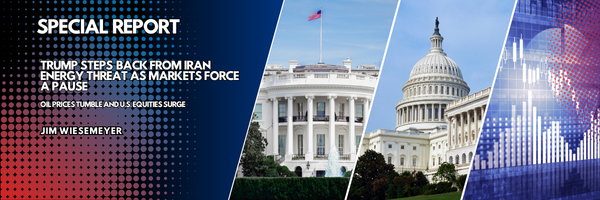
Trump Steps Back from Iran Energy Threat as Markets Force a Pause
Oil prices tumble and U.S. equities surge on Trump’s reversal, but skepticism lingers over the durability of the five-day reprieve
President Donald Trump’s decision to back away from his threat to destroy Iran’s power infrastructure amounted to a market-driven de-escalation that bought time, but wary confidence. According to Bloomberg Government, the White House move came just before U.S. markets opened Monday, after soaring oil prices and a broader global market selloff underscored the economic risks of further escalation in the U.S./Israeli war against Tehran.
The immediate effect was clear: Brent crude fell sharply, while the S&P 500 and U.S. Treasuries rebounded as investors interpreted the shift as an effort to calm markets and avoid a new shock centered on Middle East energy infrastructure. Trump himself reinforced that connection, saying oil prices would “drop like a rock” if a deal is reached, even as he insisted there was a “very serious chance” for diplomacy. The Dow surged over 1,000 points higher.
But the policy reversal also exposed deep skepticism around the administration’s strategy. Iran denied that meaningful talks had taken place and cast Trump’s retreat as proof that its own threats against regional power plants had worked. U.S. allies, meanwhile, reportedly adopted a wait-and-see posture, uncertain whether this latest pause represented a genuine diplomatic opening or simply another temporary reversal in a three-week conflict marked by abrupt shifts in White House messaging.
Trump said the U.S. has been in contact with a “respected” or “senior” Iranian leader, but did not clearly identify the person. He emphasized the talks were “very good and productive” and suggested they involved high-level representatives, not just lower-level channels.
Trump explicitly indicated the U.S. is not talking directly with Iran’s supreme leader.
He suggested the discussions are with “representatives” rather than a single clear leader, reflecting uncertainty about Iran’s leadership structure after recent strikes. In some comments, he described the contact as being with “a top person” or key figure inside the Iranian system, without naming them publicly.
Trump said the U.S. would hold off on planned strikes for five days, but made clear the pause was temporary and dependent on talks: He described the delay as being “subject to the success of the ongoing meetings and discussions.” The pause came after what he called “very good and productive conversations.”
Trump also made clear that military action is still on the table if talks fail: He warned the U.S. would continue or resume bombing if a deal is not reached.
The broader concern is that the pause may reduce immediate market stress without resolving the underlying danger. Analysts warned that if Tehran concludes threats against regional energy assets can force Washington to back down, the episode could strengthen Iran’s sense of deterrence rather than weaken it.
Meanwhile, Israel was said to be continuing operations while avoiding energy targets, signaling that the conflict itself is not on hold even if one especially dangerous escalation path has been delayed.
Regionally, Gulf states appear to have played a quiet but important role in pressing for restraint. Countries including Turkey, Saudi Arabia, Oman, and the United Arab Emirates have been involved in various backchannel efforts aimed at containing the war, with Gulf governments particularly concerned that attacks on Iranian infrastructure could destabilize the region further and threaten critical energy, water, and power systems.
The five-day reprieve may have lowered the temperature on oil and equities at the opening bell, yet the war continues, diplomacy remains contested, and investor confidence still rests on fragile ground.
Bottom Line: Trump’s reversal helped stabilize markets for now, but it did not erase the underlying geopolitical and economic risk. The five-day reprieve may have lowered the temperature on oil and equities at the opening bell, yet the war continues, diplomacy remains contested, and investor confidence still rests on fragile ground.