Trump Taps Lindberg for World Food Program — Why It Matters for U.S. Agriculture
Nomination underscores a strategic shift toward trade-driven food aid as farm groups eyed alternative leadership
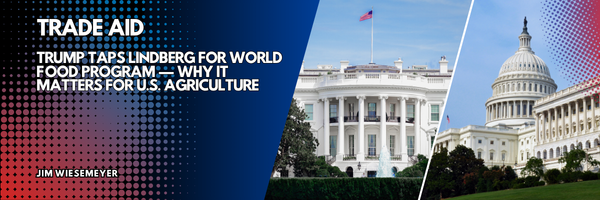
The Trump administration’s nomination of Luke Lindberg to lead the World Food Program (WFP) places a U.S. agricultural trade official at the center of the world’s largest food aid operation — a move with direct implications for U.S. farmers, commodity demand, and global food policy.
The WFP is not simply a humanitarian agency; it is one of the largest purchasers and distributors of food in the world, operating in more than 120 countries and serving well over 100 million people annually. The United States is its largest donor and has historically played a decisive role in selecting its executive director, making the position one of the most influential global food-policy posts outside Washington.
The power of the role becomes clearer when viewed alongside the Food and Agriculture Organization (FAO), which jointly appoints the WFP director with the UN Secretary-General. FAO shapes global agricultural policy, data systems, and development strategies, while WFP executes food delivery at scale — purchasing commodities, directing flows, and responding to crises. Together, the two institutions influence both how the global agricultural system is structured and how food moves through it during periods of stress.
For U.S. agriculture, that connection is highly tangible. WFP programs are deeply intertwined with U.S. food aid initiatives, including those historically tied to Food for Peace, which channel significant volumes of U.S.-grown commodities — wheat, corn, soy products, rice, and dairy powders — into global markets. These programs can provide an important demand outlet, particularly during periods of surplus, while reinforcing U.S. geopolitical influence.
A central policy question — and one that the WFP director can influence — is sourcing. Debate has long centered on whether food aid should rely more heavily on local or regional procurement in recipient countries or prioritize U.S.-produced commodities. The Trump administration has pushed more aggressively toward U.S.-origin sourcing in certain programs, viewing food aid as both humanitarian assistance and a strategic extension of agricultural trade policy. A director aligned with that approach could reinforce export demand for U.S. producers.
Lindberg’s background reflects that orientation. In his current USDA role, he has been closely involved in export promotion, market access, and the restructuring of international food aid programs. His nomination signals an effort to more tightly align food aid with U.S. trade strategy — effectively embedding a market-focused perspective within WFP leadership.
However, the choice has not been without quiet debate inside the agriculture community. Some stakeholders had looked instead to Beth Bechdol, a senior leader at FAO and a longtime agriculture policy official with deep roots in both U.S. farm policy and global food security.
Bechdol, who previously served on the Senate Ag Committee under Dick Lugar (R-Ind.), as well as in senior USDA roles, is widely regarded as a bipartisan figure with strong ties to the traditional food aid coalition — including commodity groups, NGOs, and international development institutions. Her experience at FAO has given her a systems-level view of global agriculture, from production and sustainability to food security and resilience programs.
That profile made her appealing to those who favor a more traditional balance between humanitarian objectives and support for U.S. agriculture within food aid programs. By contrast, Lindberg’s selection suggests a shift toward a more explicit integration of food aid with export strategy and geopolitical priorities.
The broader geopolitical environment further elevates the importance of the role. Food aid is increasingly tied to conflict zones, migration pressures, and climate disruptions, and WFP decisions can influence global grain flows, mitigate supply shocks, and indirectly shape commodity price dynamics. For U.S. farmers, that means leadership at WFP can have downstream effects on export demand and market stability.
The FAO’s involvement in the appointment process adds another layer. As the leading global body for agricultural policy and data, FAO helps define long-term production and food security frameworks, while WFP operates within those parameters to deliver aid. Maintaining influence across both institutions allows the United States to shape not only emergency food flows but also the broader architecture of global agriculture.
Bottom Line: Taken together, Lindberg’s nomination is not simply a personnel decision — it reflects a strategic repositioning of food aid within U.S. agricultural and trade policy. Meanwhile, the interest in Bechdol from parts of the ag sector highlights an ongoing debate over whether the future of food assistance should lean more heavily toward humanitarian systems and global development — or toward reinforcing U.S. commodity demand and export competitiveness.