Donald Trump at Davos: Power, Security, Markets, and the Case for a New Economic Order
From Greenland and global security to tariffs, markets, and affordability, President Donald Trump outlines a sweeping vision for U.S. power and economic dominance at Davos
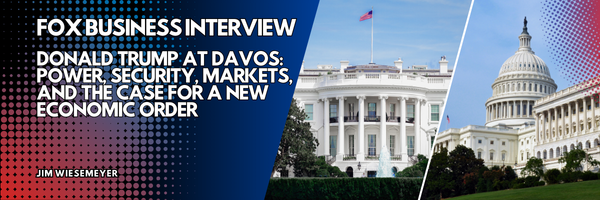
In a wide-ranging interview at the World Economic Forum in Davos, President Donald Trump laid out his strategic vision on Greenland, Iran, Europe, defense spending, tariffs, free-market capitalism, affordability, and the political stakes ahead — framing the moment as a historic realignment of U.S. power and economic policy.
Setting the Stage: A “Major Moment in History”
Appearing on Mornings with Maria from Davos, President Trump framed the interview as a defining juncture — linking national security, economic revival, and global leverage. The conversation moved briskly from geopolitics to markets, from missile defense to grocery prices, underscoring the administration’s thesis: strength abroad and discipline at home reinforce one another.
Greenland and the “Golden Dome”: Security First
Trump described a developing framework with NATO leadership that would give the United States total access to Greenland — military basing, equipment placement, and strategic reach — without a traditional purchase. While stopping short of confirming a formal acquisition, he argued Greenland’s geography is indispensable to U.S. and allied missile defense.
At the center of that strategy is the “Golden Dome” — a next-generation missile shield inspired by Israel’s Iron Dome but scaled dramatically. Trump said modern technology now makes near-perfect interception feasible, reviving a concept once envisioned by Ronald Reagan but previously constrained by technical limits. Greenland, he said, expands coverage and accuracy because “everything comes over Greenland.”
Key takeaways
• No fixed time limit or lease; access would be enduring
• Missile defense coverage improves materially with Greenland’s geography
• Emphasis on U.S.-made systems and faster production timelines
Defense Spending and Industrial Mandates
Trump reiterated support for a $1.5 trillion defense budget in 2027, arguing the global environment requires unmatched readiness. Funding, he said, would be supported by tariff revenue and investment inflows.
He defended controversial steps aimed at defense contractors — restricting stock buybacks and dividends until production accelerates—calling it a national security exception to free-market norms. The goal: rapid delivery of Patriots, Tomahawks, F-35s, and other systems measured in months—or even days—rather than years.
Tariffs, the Supreme Court, and Leverage
The president emphasized tariffs as both revenue and leverage, projecting hundreds of billions of dollars annually. He acknowledged pending Supreme Court scrutiny but insisted alternative authorities would be used if necessary. Tariffs, he argued, are driving a historic wave of onshoring — citing pharmaceutical manufacturing and advanced industry investments.
Bottom Line: tariffs are not just trade tools; they are catalysts for domestic capital formation.
Europe, NATO, and Reciprocity
Pressed on European backlash — particularly rhetoric from France and concerns about retaliatory financial moves — Trump stressed reciprocity. He reiterated long-standing complaints that NATO burdens had been uneven, noting U.S. troop deployments across Europe and questioning whether allies would respond in kind if America ever needed them.
While dismissing threats of asset sales as manageable, Trump warned that retaliation would be met decisively, arguing the U.S. “has all the cards.”
Iran, Venezuela, and Deterrence
Trump described recent military actions as decisive deterrence:
•Iran: elimination of nuclear capacity in a single operation, which he said changed the balance of power and prevented broader conflict.
•Venezuela: a precision strike on a major military facility executed without U.S. casualties or losses.
He also claimed U.S. pressure halted mass executions in Iran, framing it as proof that credible threats can save lives. Asked about future intervention, Trump declined to speculate, emphasizing strategic ambiguity.
Free Markets—With Guardrails
Challenged on whether government stakes and mandates contradict free-market capitalism, Trump drew a distinction between normal markets and national security. Defense, he argued, cannot be allowed to prioritize financial engineering over output. Outside that realm, he maintained, the administration is unleashing private enterprise at unprecedented scale.
Affordability: Gas, Food, Credit, and Housing
Trump pivoted to household economics, arguing that falling energy prices are the most powerful inflation cure. He cited gasoline prices near $1.99 in some areas and falling food costs as evidence policy is “working.”
Additional affordability measures discussed:
• Cap on credit card interest rates to curb usury
• Mortgage-backed securities purchases to support housing finance
• Restrictions on institutional ownership of single-family homes
• Tax changes: no tax on tips, Social Security, or overtime; accelerated expensing for new plants
He dismissed bank industry warnings about profit impacts, saying consumers must be stabilized after years of inflation.
Health Care: Paying People, Not Insurers
Trump sharply criticized insurer windfalls under Obamacare and floated directing federal health dollars straight to individuals, via accounts or direct payments, to purchase coverage themselves. He argued this would lower costs and improve care — while acknowledging fierce political resistance from entrenched interests.
Politics, the Border, and the Midterms
Trump touted a fully closed southern border, a rapid decline in crime in Washington, D.C., and a surge in legal immigration to meet labor demand. Yet he acknowledged history’s headwinds: presidents often lose midterms regardless of performance. Still, he insisted growth, security, and visible gains could break the pattern.
The Trump Thesis at Davos
Across topics, a consistent logic emerged:
1) Security enables prosperity
2) Leverage beats accommodation
3) Markets thrive when rules serve the nation, not rent seekers
Whether on Greenland’s ice, Europe’s balance sheets, or Main Street’s grocery bills, Trump framed the moment as a reset — one he argues is already reshaping investment flows, alliances, and the domestic economy.
“We created a miracle,” he said. “Now we have to keep it.”