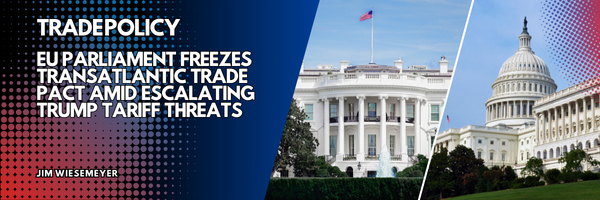
EU Parliament Freezes Transatlantic Trade Pact Amid Escalating Trump Tariff Threats
Greenland dispute and new U.S. levies derail ratification of tariff truce meant to stabilize U.S/EU trade
A flagship U.S./EU trade agreement aimed at easing transatlantic tariff tensions has been put on ice after President Donald Trump announced new tariffs on European countries linked to his pressure campaign over Greenland.
EU lawmakers confirmed they will not move forward with ratification of the deal — signed last July by Trump and European Commission President Ursula von der Leyen — amid mounting political backlash in Brussels. The pact would have capped U.S. tariffs on EU imports at 15% in exchange for the EU lifting tariffs on American goods.
Note: The U.S./UK trade accord is legally separate from EU policy and is unaffected by the EU Parliament’s decision. However, President Trump’s tariff threat was unilateral and explicitly included the UK, meaning Britain is not automatically exempt. UK Prime Minister Keir Starmer publicly condemned the tariff threat, calling it “completely wrong.” He emphasized that Greenland’s future is a matter for Denmark and the people of Greenland, and criticized tariffs on NATO allies for collective security work. Starmer said the UK would pursue the issue directly with the U.S. administration.
Manfred Weber, president of the center-right European People’s Party (EPP), said escalating tensions made approval impossible for now. “The EPP is in favor of the EU-U.S. trade deal, but given Donald Trump’s threats regarding Greenland, approval is not possible at this stage,” Weber said, adding that zero-tariff treatment for U.S. exports must be suspended.
The shift is significant because Weber’s party had previously resisted calls from other pro-EU groups — including the Socialists & Democrats, Renew, and the Greens — to pause implementation. A vote had been expected later this month in the European Parliament, but support has now collapsed across multiple blocs.
The breakdown follows Trump’s announcement of an additional 10% tariff on European countries contributing troops to a small deployment in Greenland, with the rate set to rise to 25% by June 1 unless Washington reaches a deal for the island’s “complete and total purchase.” European officials say the deployment was meant to address security concerns, not provoke the U.S.
Several lawmakers are now openly urging retaliation. Karin Karlsbro, Renew’s trade coordinator, said the EU must prepare countermeasures, including use of the bloc’s Anti-Coercion Instrument — the so-called trade “bazooka” that allows restrictions on investment, procurement access, and intellectual property protections.
Center-left lawmakers echoed that view, arguing that approving the trade pact under pressure would legitimize economic coercion.
Meanwhile, European Council President António Costa warned Washington that any new U.S. tariffs would trigger a coordinated EU response.
With ratification stalled and retaliation now openly discussed, the fragile U.S./EU trade truce appears increasingly uncertain as the Greenland dispute spills into broader economic conflict.