Fed Signals Cautious Path Toward Rate Cuts Amid War-Driven Uncertainty
FOMC minutes show policymakers balancing inflation risks, labor weakness, and geopolitical shocks
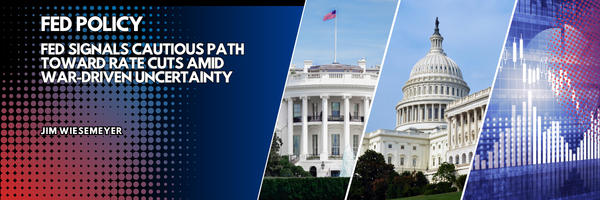
Federal Reserve officials still expect to cut interest rates in 2026 — but only cautiously — as they weigh the competing impacts of war-driven inflation risks and a softening labor market, according to minutes from the March meeting of the Federal Open Market Committee.
Rate cuts remain the base case. The minutes reinforce that policymakers are still leaning toward one rate cut this year, provided inflation continues to move toward the Fed’s 2% target. Many participants indicated that easing would likely become appropriate over time, signaling that the central bank has not abandoned its expectation of gradual policy normalization.
Meanwhile, officials emphasized the need to remain “nimble,” underscoring that the outlook has become more uncertain and increasingly dependent on incoming data.
War-driven inflation risk complicates the outlook. The Iran conflict has introduced a more complex policy environment. Rising energy prices are creating a two-sided risk: they could slow growth by squeezing household purchasing power while also keeping inflation elevated longer than expected.
This tension is central to the Fed’s current posture. While some policymakers see a case for easing if higher fuel costs weigh on demand and employment, others cautioned that persistent inflation pressures could justify holding rates steady — or even tightening further if price stability deteriorates.
Labor market weakness is a growing concern. The labor market is emerging as a key pressure point in the Fed’s deliberations. Officials noted that overall job creation has been subdued and concentrated heavily in healthcare, raising concerns about the durability of employment gains.
The minutes explicitly state that risks to the employment side of the Fed’s mandate are “skewed to the downside,” with several participants warning that the labor market appears vulnerable to adverse shocks — particularly in a low-growth environment.
Fed holds steady amid uncertainty. Against this backdrop, the Federal Reserve voted 11–1 to keep its benchmark rate unchanged at 3.5%–3.75% at the March meeting.
Jerome Powell has also indicated that reacting too aggressively to near-term inflation spikes could risk longer-term economic damage, given the lagged effects of monetary policy.
Slowing growth reinforces easing bias. Economic data continues to point to a slowdown, with GDP growth at just 0.7% in the fourth quarter of 2025 and tracking near 1.3% for the first quarter of 2026. That deceleration is reinforcing expectations that the Fed may ultimately need to provide support, even as inflation remains above target.
Bottom Line: The Fed’s March minutes outline a policy path defined by conditionality. Officials still anticipate rate cuts this year, but only if inflation eases and labor market conditions weaken further. Meanwhile, geopolitical risks — particularly energy-driven inflation — remain the key wildcard that could delay or even reverse that trajectory.