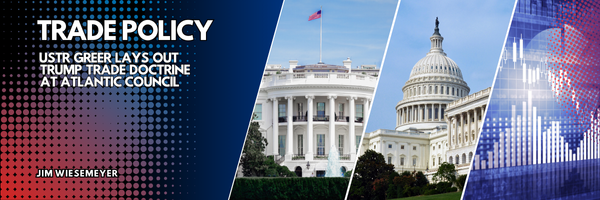
USTR Greer Lays Out Trump Trade Doctrine at Atlantic Council
USTR Jamieson Greer defends tariff strategy, previews USMCA overhaul, and outlines the administration’s post-WTO vision for global trade
At a packed Atlantic Council “Front Page” event, U.S. Trade Representative (USTR) Jamieson Greer delivered his most expansive explanation yet of the Trump administration’s trade strategy — defending aggressive tariff actions, previewing fundamental changes to USMCA, and signaling a shift toward an interest-based global trade order.
Greer, interviewed by Wall Street Journal columnist Greg Ip, also addressed the looming Supreme Court case on IEEPA tariffs, tensions with China and the EU, and the administration’s push to build a hemispheric trade bloc anchored in U.S. economic power.
I. Setting the Stage: A New Global Trading System
Greer was introduced as the architect of a sweeping remaking of U.S. trade policy—what he calls the emerging “Turnberry system,” a departure from Bretton Woods–era liberalization.
Key points:
• U.S. effective tariff rate has risen from 2.5% to over 15%, the highest in 80 years.
• Trump’s second term has been defined by tariffs, managed trade, and reindustrialization goals.
• Greer frames this shift as correcting decades of neglect of manufacturing and national security concerns.
II. Administration Scorecard: Tariffs, Wages, Manufacturing
Greer defended the administration’s metrics for success — shrinking the trade deficit, raising real household incomes, and reviving manufacturing.
Trade Deficit Trends
• Front-running of tariffs led to a surge in early-year imports, but since August the deficit has “fallen sharply,” especially with China, down ~25% year-over-year.
• He argues the second-half trend reflects “the right direction” of policy.
Wages & Investment
• Blue-collar wages are rising, Greer said.
• Core capital goods shipments hit all-time highs; factory construction and private fixed investment are surging.
Manufacturing Employment
• Acknowledges recent softness but attributes it partly to immigration-driven labor market distortions.
• Says factory investment indicators matter more than short-term hiring numbers.
III. What Should Be Reshored? Greer’s Theory of Manufacturing Ecosystems
Greer rejects the idea that only “strategic” sectors deserve reshoring incentives.
• Critical sectors: autos, semiconductors, pharmaceuticals, robotics, steel, fertilizer.
• But he insists ecosystems bring along other industries—“I’m not turning my nose up at pencils or toys.”
• Manufacturing jobs pay more than services and create innovation spillovers.
Greer Atlantic
IV. USMCA: Preparing for a Major Overhaul
With the USMCA’s mandatory six-year “sunset review” approaching, Greer previewed dramatic possibilities.
Key Fixes Needed
• Automotive rules of origin need strengthening to stem production shifting to Mexico.
• Low MFN auto tariff (2.5%) limited U.S. leverage last time; Section 232 auto tariffs have now altered that landscape.
• He wants similar content-increasing rules for non-auto sectors.
Bilateral, Not Trilateral?
• Greer revealed he has not met jointly with Canada and Mexico this year.
• Says U.S. relationships with each economy are too different for a one-size-fits-all renegotiation.
• Openly acknowledged that exit from USMCA is an option under the sunset clause.
V. The Supreme Court Case: What if IEEPA Tariffs Fall?
Greer would not disclose the contingency plan but gave several signals:
• The administration has mapped multiple statutory authorities (e.g., Sections 232, 301, 122).
• He is confident equivalent tariff levels and revenue — now running at ~$200B annually — could be recreated.
• Acknowledged refunds would be significant but deflected the operational question to CBP and Treasury.
VI. Tariffs, Revenue, and Possible Congressional Action
Greer said many lawmakers have privately urged him to consider legislating permanent tariff baselines.
Ideas discussed:
• Raising MFN tariffs across the board—e.g., a global 10% floor.
• Allowing higher rates for deficit-driving or unfair-trade jurisdictions.
• Establishing a China-specific tariff chapter (though Greer prefers integrating it into a global framework).
VII. Business Concerns: Complexity and Compliance
Acknowledging complaints of overlapping tariff regimes (IEEPA, 232, 301), Greer said:
• The system was already complex; a transformation of this scale inevitably introduces operational friction.
• CBP guidance has reduced confusion about “stacking” of tariffs.
• The administration remains open to further simplification but will not dilute policy goals.
VIII. China: From Confrontation to “Managed” Economic Coexistence
Greer stressed the administration is “pro-American, not anti-China,” rejecting hawk/dove labels.
Key Themes
• The goal is balanced trade, not decoupling.
• Trade with China should be “managed,” determining which goods each side buys and sells.
• High-tech sectors will remain fenced off, but broad categories (consumer goods, agriculture, aircraft, medical devices) should continue flowing.
• The U.S. sees value in provisions (like those in the Malaysia agreement) that require partners to mirror U.S. restrictions on third-country imports—an implicit China-containment tool without naming China.
IX. EU Tensions: Digital Regulation as Trade Barrier
Greer expressed frustration with the EU’s implementation of the Digital Markets Act and Digital Services Act.
• Argues the EU is setting global regulatory rules by default, disadvantaging U.S. firms.
• Says U.S. companies should be regulated by the U.S., not Brussels.
• Warned that discriminatory digital regulation will factor into tariff negotiations.
X. Emerging Flashpoints: Indonesia, Brazil, and Southeast Asia
Indonesia
• Reports of balking on agreements; Greer says he wants a deal and will press his counterpart directly.
• Notes recent successes with Malaysia and Cambodia and wants Indonesia in that group.
Brazil
A major Section 301 investigation is underway, covering:
• Agricultural practices (e.g., soybean-linked Amazon deforestation).
• Digital barriers.
• Foreign-policy concerns, including treatment of U.S. citizens and tech firms.
Greer says progress has been made — Brazil benefited from recent tariff rollbacks on coffee and cocoa — but more concessions are required.
XI. Tariff Recalibrations: Why Coffee and Bananas Were Exempted
Responding to WSJ reporter Gavin Bade, Greer explained that the administration always intended to adjust certain tariffs as leverage produced results.
• September executive order authorized removals tied to trade-deal progress.
• Foods like coffee and bananas were reduced after new deals with Ecuador, Guatemala, Vietnam, and Cambodia.
• Price effects, he argued, are often overstated; exporters frequently “eat the tariff” to maintain access to the U.S. market.
XII. The Post-WTO Trade Order: Greer’s Vision
In the event’s final question, Greer offered a blunt diagnosis:
• The “rules-based international order” is effectively dead—if it ever truly existed.
• The WTO cannot address overcapacity or transparency failures.
• The new system will be layered U.S. bilateral and plurilateral agreements, anchored in U.S. market power and economic security.
• Trade will be interest-based, not consensus-based.
Conclusion
Greer’s appearance made clear that the administration sees its tariff regime not as a temporary disruption but as the foundation of a durable new trade architecture.
Managed trade, reshoring, bilateral leverage, and U.S.-defined standards — especially in digital and industrial policy — will shape what he calls the “Turnberry system.”
The session underscored that 2026 will be a pivotal year: a potential USMCA rewrite, a Supreme Court ruling that could upend tariff authority, and intensifying global tension over China and overcapacity. Yet Greer projected confidence that the administration’s strategy — rooted in economic security and unilateral U.S. leverage — will endure regardless of legal or diplomatic turbulence.