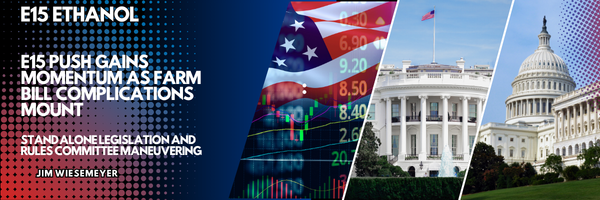
E15 Push Gains Momentum as Farm Bill Complications Mount
Standalone legislation and Rules Committee maneuvering aim to secure year-round ethanol sales amid budget and policy hurdles
The Nationwide Consumer and Fuel Retailer Choice Act of 2025 (HR 1346) has emerged as a central legislative vehicle in the push to expand nationwide access to higher ethanol blends, even as broader farm bill negotiations encounter mounting complications. The bill would amend the Clean Air Act to ease Reid Vapor Pressure (RVP) restrictions, effectively enabling the year-round sale of E15 (gasoline blended with 10–15% ethanol) across the United States.
At its core, the legislation resolves a longstanding regulatory barrier that has limited E15 availability during the summer ozone season. By clarifying that qualifying fuels can bypass certain RVP constraints and expanding statutory language to include blends of “10 to 15 percent” ethanol, the bill aligns federal law with the policy goal of nationwide E15 access. Meanwhile, it also includes provisions allowing small refineries to reclaim or reuse renewable fuel compliance credits from prior years, addressing industry concerns tied to the Renewable Fuel Standard.
The legislative path for E15 has become increasingly intertwined with the fate of Farm Bill 2.0. What had been expected to be a relatively straightforward component of the broader agriculture package has instead become a point of friction. Farm-state lawmakers have been pushing to include year-round E15 sales in the farm bill, a policy that House GOP leadership had pledged for months.
That effort hit a procedural and fiscal roadblock when the Congressional Budget Office determined that a proposed amendment from Rep. Michelle Fischbach (R-Minn.) — which would have achieved similar E15 expansion — would add billions of dollars to the federal deficit over the 10-year budget window. That finding complicated its inclusion under budget constraints governing the bill.
In response, the House Rules Committee added a separate measure to its agenda for an afternoon meeting today that would permit year-round E15 sales outside the farm bill framework. The move suggests leadership is attempting to sidestep budget scoring challenges while still delivering on a key priority for Midwestern lawmakers and the ethanol industry.
Whether this maneuver resolves the farm bill’s internal tensions remains uncertain. But the convergence of HR 1346 and parallel Rules Committee action underscores how E15 policy has shifted from a technical fuel regulation issue into a central political and fiscal battleground within U.S. agriculture and energy legislation.